A common argument people make is this:
India has:
1.4 billion people
one of the world’s largest internet populations
cheap mobile data
millions of creators
a massive young audience
Yet India still hasn’t produced a social media platform that truly competes globally with Instagram or TikTok.
And honestly, at first glance, that sounds surprising.
Because from the outside, it feels like India has all the ingredients needed to build the next big consumer internet company.
People often say the reason is simple:
Building social media products is much harder than it looks.
You can copy:
code
UI
features
short video formats
But you cannot easily copy:
culture
user behavior
retention
creator ecosystems
recommendation systems
network effects
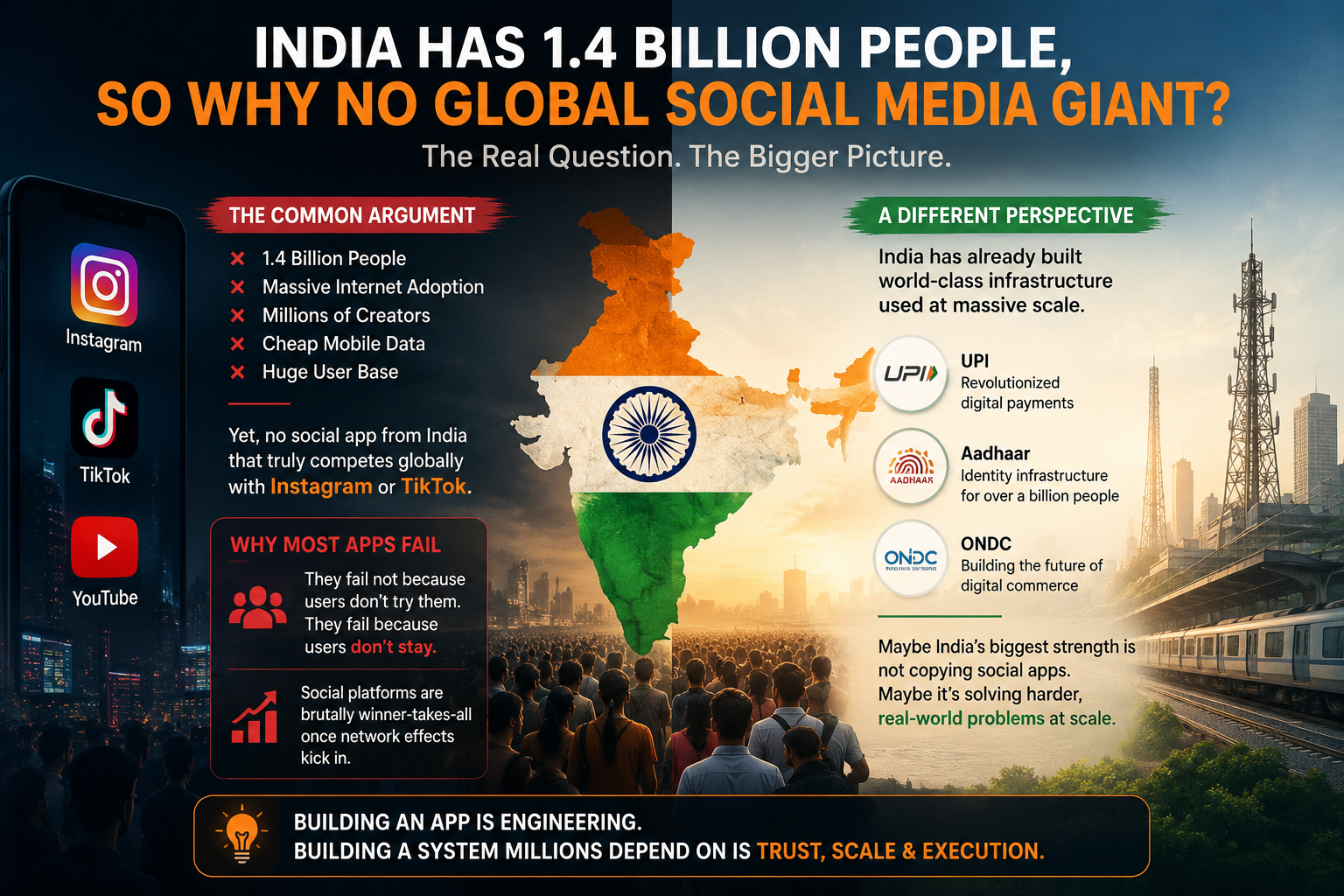
Most apps do not fail because users never try them. They fail because users leave. And once social platforms reach scale, the market becomes brutally winner-takes-all. This is usually presented as proof that India still struggles to build world-class consumer products. But I think that entire framing is flawed.
The Bigger Question Nobody Asks
Why do we use social media addiction apps as the primary benchmark of technological success?
India has already built systems operating at unbelievable scale.
Consider what India has achieved:
UPI transformed digital payments
Aadhaar built identity infrastructure for over a billion people
Jio fundamentally changed internet accessibility
CoWIN managed vaccination logistics at population scale
ONDC is attempting to decentralize digital commerce
These are not small achievements.
These are infrastructure-level systems handling real-world complexity for hundreds of millions of users simultaneously.
And in many ways, these problems are far harder than building another short-video platform.
Social Media Success Is Not Just About Engineering
People often oversimplify social media success.
Instagram did not win only because of superior engineering.
TikTok did not dominate only because of better code.
A massive part of success came from:
timing
aggressive funding
geopolitical influence
app-store ecosystems
creator monetization
global expansion advantages
advertising infrastructure
early network effects
Once a platform captures user attention at global scale, it becomes extremely difficult for competitors to break that habit loop.
Social media is less of a pure engineering problem and more of an attention monopoly game.
India May Be Optimizing for Different Problems
Maybe India’s biggest strength is not creating the next dopamine-scroll platform.
Maybe its strength lies elsewhere:
digital infrastructure
fintech
AI tooling
scalable public systems
developer ecosystems
education technology
healthcare accessibility
automation platforms
The world already has enough applications competing for human attention.
But there are still massive unsolved problems in:
governance
payments
education
logistics
accessibility
digital identity
AI infrastructure
And India has already shown it can build systems at population scale.