How AI Is Turning Everyday Photos Into a Cybersecurity Nightmare
What once looked like harmless social media fun is now becoming a serious cybersecurity concern. Experts are warning that artificial intelligence has become powerful enough to extract fingerprint patterns from ordinary high-resolution photos posted online.
And unlike a password, your fingerprints cannot be changed.
Cybersecurity researchers say this could open the door to a future where identity theft is no longer limited to stolen passwords or hacked emails. Instead, your own photos could become the key hackers use against you.
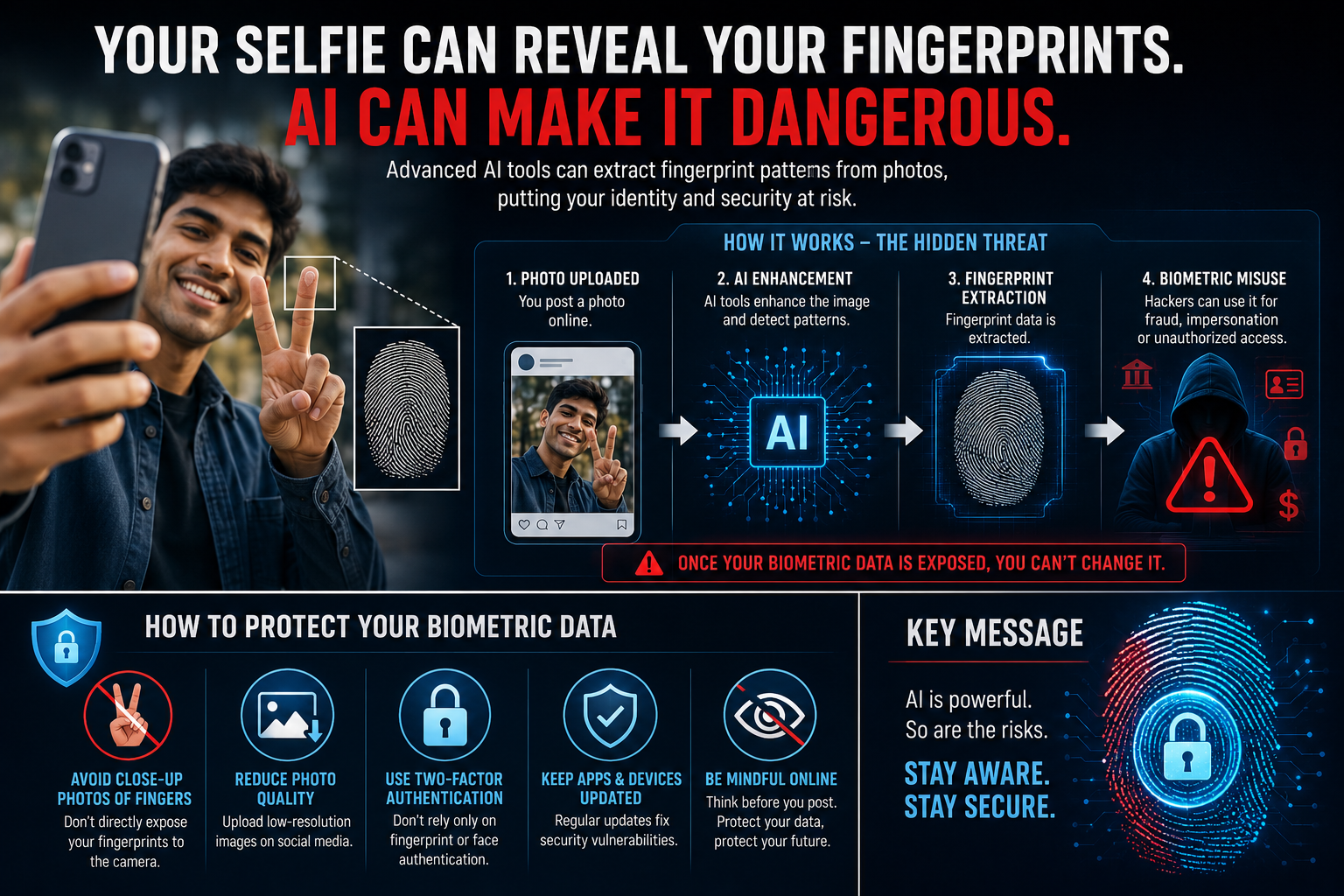
The “Peace Sign” Problem
For years, the peace sign has been one of the most common selfie poses worldwide.
But security expert Li Chang recently demonstrated how AI-enhancement tools can sharpen and reconstruct fingerprint details from photos where fingers are clearly visible. According to experts, if fingers are directly facing the camera from close range, fingerprint patterns may become surprisingly recoverable.
Modern smartphones already capture ultra-detailed images. Combine that with AI image enhancement, and blurry finger pads can potentially become usable biometric data.
What sounds like science fiction is slowly becoming reality.
Why This Is More Dangerous Than Password Theft
Today fingerprints are used everywhere:
Smartphone unlocking
Banking apps
Office attendance systems
Airport security
Aadhaar-linked verification systems
Digital payments
Smart home locks
Once biometric information is compromised, criminals could potentially misuse it for years.
AI Is Changing Cybercrime Faster Than Governments Can React
Artificial intelligence is no longer just creating art or chatbots. It is now capable of:
Enhancing blurred images
Reconstructing missing patterns
Generating realistic deepfakes
Mimicking voices
Cloning faces
Predicting personal information from online data
Cybercriminals are increasingly using AI because it automates tasks that once required advanced technical skills.
A teenager with the right AI tools today can perform operations that previously required a team of skilled hackers.
That is the frightening part.
The Future Risks Nobody Is Talking About
Experts fear that biometric harvesting could evolve into a large underground black market.
Imagine this scenario:
Someone uploads travel photos publicly
AI extracts partial fingerprint patterns
Data gets combined with leaked Aadhaar, PAN, or phone records
Criminals build a complete digital identity profile
This could lead to:
Financial fraud
Fake biometric verification
Unauthorized device access
Identity impersonation
Deepfake-supported scams
Surveillance abuse
As AI improves, even partial fingerprints may become enough for dangerous misuse.
Are Governments Prepared?
Many cybersecurity analysts believe governments worldwide are still behind the speed of AI evolution.
Most countries currently lack strong laws specifically addressing:
AI-generated identity fraud
Biometric data harvesting
Deepfake impersonation
AI-powered surveillance abuse
Authorities are now being pushed to create stricter regulations around:
Social media image protection
AI tool accountability
Biometric security standards
Ethical AI development
Digital identity safeguards
Countries like India, the US, China, and members of the European Union are all racing to strengthen cyber laws before AI abuse grows further.
What People Should Do Right Now
Experts are not asking everyone to stop taking photos.
But they strongly recommend becoming more aware of what is visible online.
Smart Habits for Better Protection
Avoid extremely close-up selfies showing fingertips clearly
Reduce public upload quality for personal photos
Limit public access to high-resolution images
Avoid posting sensitive documents online
Use strong two-factor authentication instead of relying only on fingerprints
Keep banking and personal apps updated
Be cautious about AI face-editing apps requesting photo permissions
Parents are also being advised to monitor what children upload online because younger users often share high-resolution images without understanding the risks.
The Bigger Question: Convenience vs Privacy
Society embraced biometric security because it felt futuristic and convenient.
But convenience always comes with a cost.
The same AI technology helping doctors detect diseases, helping students learn faster, and helping businesses automate work can also become a weapon in the wrong hands.
The challenge for humanity is no longer whether AI will become powerful.
It already is.
The real question is whether laws, ethics, and public awareness can evolve fast enough to keep people safe before cybercrime enters a completely new era.
One thing is becoming increasingly clear:
In the AI age, even a selfie may no longer be “just a selfie.”